
First Battle of St Albans: How a Street Fight Sparked the Wars of the Roses
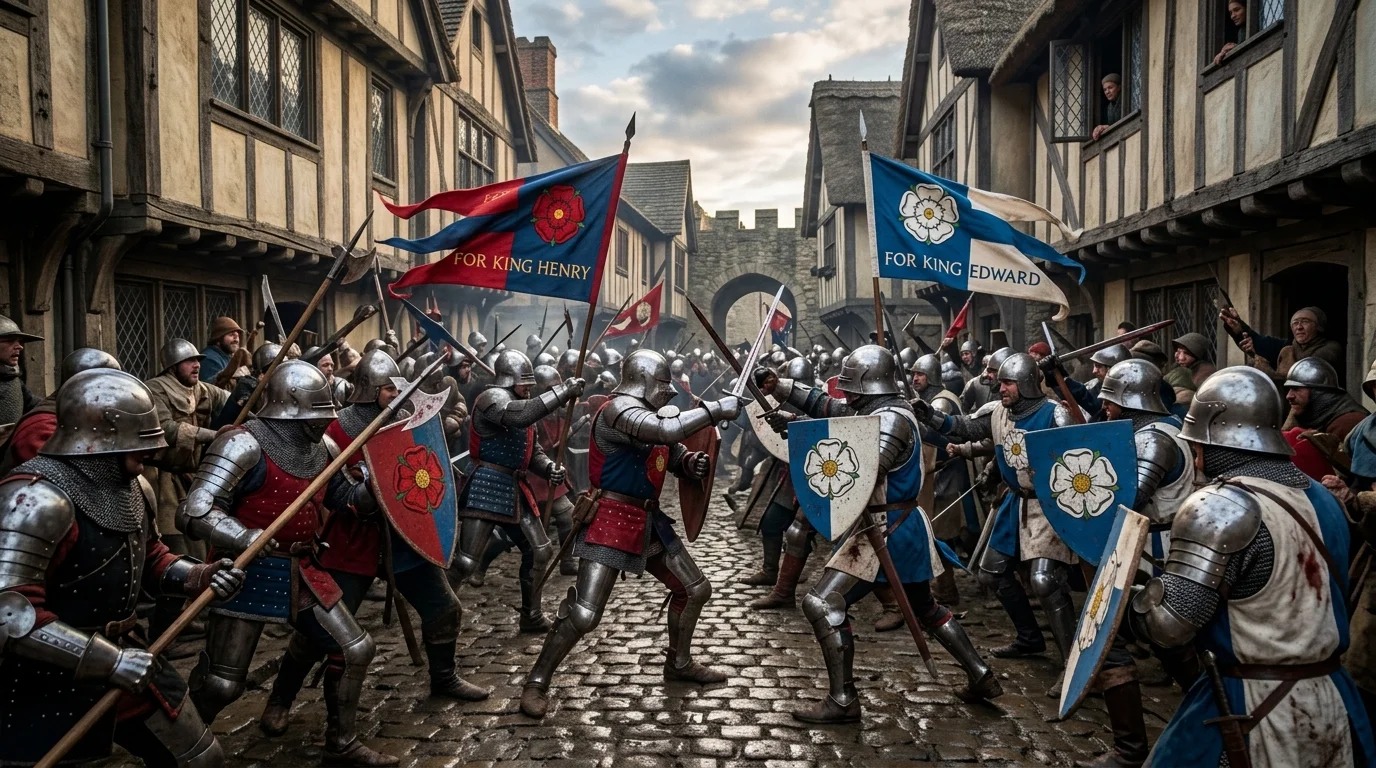
On May 22, 1455, the narrow, timber-framed streets of St Albans in Hertfordshire became the site of a brief but violent confrontation that fundamentally altered English history. While many medieval battles were fought on vast, open fields, this engagement was a chaotic urban skirmish that lasted barely an hour. Despite its brevity, the First Battle of St Albans is recognized by historians as the traditional starting point of the Wars of the Roses, a thirty-year dynastic struggle between the House of Lancaster and the House of York.
Reader context
- Date: May 22, 1455.
- Location: St Albans, Hertfordshire, England.
- Key Figures: King Henry VI (Lancaster) vs. Richard, Duke of York.
- Outcome: Yorkist victory, capture of the King, and the death of several high-ranking Lancastrian nobles.
- Historical Impact: This day transitioned a political rivalry into a military conflict that lasted until 1487.
The Political Crisis of 1455: York vs. Lancaster
By the mid-15th century, the English monarchy faced a crisis of leadership. King Henry VI, a pious but ineffective ruler, suffered from bouts of mental illness that left the government paralyzed. This power vacuum led to a bitter rivalry between the King’s closest advisors, led by Edmund Beaufort, Duke of Somerset (House of Lancaster), and Richard, Duke of York.
Richard of York argued that he was the rightful protector of the realm and sought to remove Somerset from power, accusing him of mismanagement and losing English territories in France. When Henry VI recovered his health in early 1455 and restored Somerset to favor, York and his allies, the Earls of Salisbury and Warwick, raised an army in the north. They marched toward London, ostensibly to “deliver” the King from his “evil counselors.”
Tactical Street Fighting in Medieval St Albans
The two forces met at St Albans on the morning of May 22. The Lancastrian army, numbering approximately 2,000 men, arrived first and took up defensive positions within the town. They blocked the main entrances at Sopwell Lane and Shropshire Lane (now Victoria Street). The Yorkist force, slightly larger at around 3,000 men, camped in Key Field to the east.
Negotiations lasted for several hours but failed when the King refused to hand over the Duke of Somerset. Around 10:00 AM, the Yorkists launched a frontal assault on the barricades. The Lancastrian defenses held firm initially, utilizing the narrow geography of the town to neutralize the Yorkist numerical advantage.
The stalemate was broken by Richard Neville, Earl of Warwick. In a move that demonstrated the tactical innovation that would characterize his career as the “Kingmaker,” Warwick led his men through the back gardens and houses between the main streets. They burst into the Market Square, catching the Lancastrian defenders by surprise. The sudden appearance of Yorkist soldiers in the heart of the town caused a panic, and the street fighting turned into a rout.
The Casualties of May 22 and the Capture of the King
The battle was remarkably lethal for the Lancastrian leadership. Unlike many medieval battles where common soldiers bore the brunt of the casualties, the Yorkists specifically targeted the noblemen surrounding the King. The Duke of Somerset was killed outside the Castle Inn. The Earl of Northumberland and Lord Clifford also fell during the fighting.
King Henry VI was found abandoned in the local marketplace, having been wounded in the neck by an arrow. He was taken to the safety of the St Albans Abbey (now St Albans Cathedral). Although the Yorkists had technically rebelled against the crown, they treated the King with outward deference. Following the battle, Richard of York knelt before Henry, claiming he only sought to eliminate the King’s enemies. This victory allowed York to be appointed Lord Protector for a second time, effectively seizing control of the government.
Visiting the 1455 Battlefield Landmarks Today
Unlike many vanished battlefields, the geography of the First Battle of St Albans remains largely recognizable within the modern city center. Visitors can still walk the routes where the House of York broke through the Lancastrian lines.
- St Albans Cathedral: The site where King Henry VI sought sanctuary after the battle. The Cathedral houses the remains of many who died in the conflict, though many of the Lancastrian lords were buried in the now-lost Lady Chapel of the time.
- The Clock Tower: Located near the Market Place, this 15th-century structure stood during the battle and would have overlooked the final, bloody stages of the street fighting.
- St Peter’s Church: The churchyard was used as a burial ground for many of the soldiers who fell during the engagement. The street leading to the church, St Peter’s Street, was one of the primary axes of the conflict.
- Holywell Hill and Sopwell Lane: These areas mark the locations of the original Lancastrian barricades where the initial Yorkist assaults were repelled.
While the First Battle of St Albans resulted in relatively few total casualties—estimated between 100 and 300 men—its political consequences were seismic. It proved that the dynastic disputes of the English nobility would no longer be settled in the council chamber, but on the battlefield, setting the stage for decades of civil war.
Source: Historic UK
Context & actions About this article
Source check Historical Record
This account is based on records from Historic UK and the historical archives of St Albans Cathedral regarding the events of May 22, 1455.
- Confirmed battle date: May 22, 1455
- Verified locations of Lancastrian barricades
- Cross-referenced casualty lists of high-ranking nobles
- Source
- Historic UK
- Scope
- St Albans
- Updated
- 2026-05-23 07:02
Source check
Report a trust issue
Send a clear signal to community moderation if the source, facts or context need review.




Comments