
Milton Keynes growth pitch targets homes and jobs: what residents need to know

Milton Keynes is putting more than £1.8 billion in named development opportunities in front of investors, alongside a wider pipeline tied to new homes, jobs, transport links and city centre regeneration.
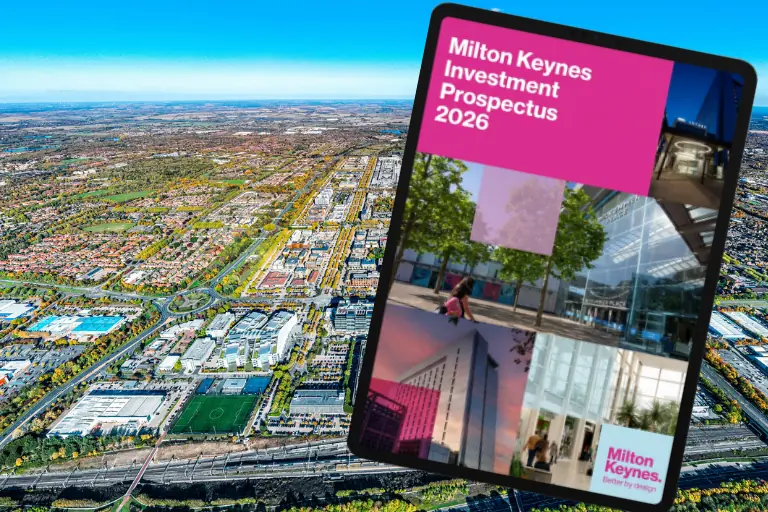
Milton Keynes City Council unveiled its latest investment prospectus at UKREiiF, setting out how one of the UK’s fastest-growing cities wants to turn population growth and economic strength into long-term development. The pitch is not a single funded programme. It is a prospectus: a set of investable sites, strategic growth areas and partnership opportunities intended to attract private and public-sector backing.
The council says the city now has more than 300,000 residents, supports over 200,000 jobs and produces more than £16.7 billion in gross value added. Productivity is described as around 25% higher than the UK average, a figure the authority is using to argue that Milton Keynes remains a high-output location for employers and developers.
Read also: Cambridge care home residents avoid more hospital stays
The headline numbers behind the investment case
| Measure | Figure in the prospectus |
|---|---|
| Population | More than 300,000 residents |
| Jobs supported | More than 200,000 |
| Economic output | Over £16.7bn GVA |
| Productivity | Around 25% above UK average |
| MK Gateway | £240m mixed-use scheme |
| Lower Westside Block B4 | £1.6bn-plus opportunity |
These figures show the scale of the council’s pitch, but they do not prove that every scheme will be delivered at the stated value or timetable. Investment prospectuses are designed to attract partners and test market appetite. Delivery will still depend on planning, funding, land assembly, infrastructure capacity and wider economic conditions.
The named sites give the clearest view of what is closest to market. MK Gateway is presented as a £240 million mixed-use scheme in Central Milton Keynes, with Grade A offices, Build-to-Rent homes and workspace for small and medium-sized firms. Lower Westside, known as Block B4, is described as a £1.6 billion-plus strategic mixed-use opportunity with potential for commercial, residential, research and education uses, aligning with the kind of business and innovation audience likely to plan around the city’s October tech dates.
Homes, offices and transport sit at the centre of the pipeline
Beyond the two development-ready sites, the Milton Keynes investment prospectus points to several longer-term growth areas.
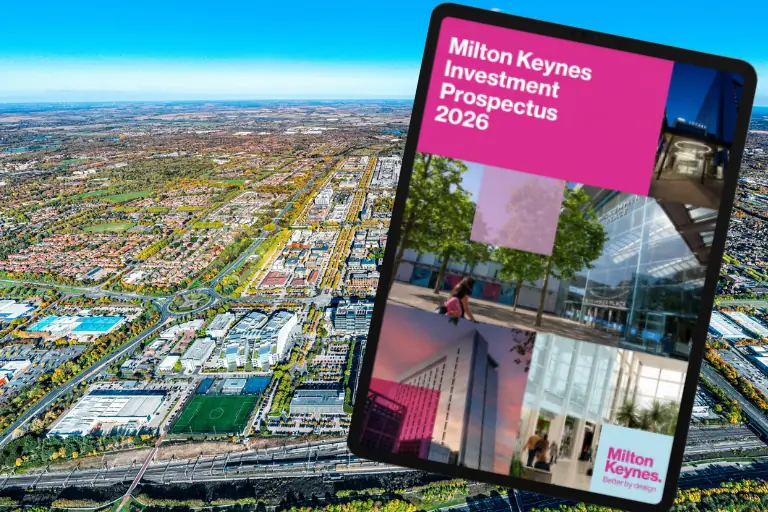
The MK East Expansion Area is expected to deliver thousands of new homes, schools, parks and supporting infrastructure. In the city centre, regeneration around Central Milton Keynes and Station Square is being framed as a route to more commercial, residential and leisure space in a prime location.
Transport is also central to the investment story. East West Rail is expected to strengthen links between Oxford, Milton Keynes and Cambridge, potentially widening the city’s labour market and making development sites more attractive to employers. Locally, rail access is already part of the wider regeneration conversation, including previous plans for better station access in Bletchley.
The prospectus also highlights innovation and technology clusters, including the city’s existing reputation for autonomous vehicles, digital systems and smart city work. Strategic employment and logistics sites are being pitched on the back of Milton Keynes’ central UK location.
Universal Studios and culture bid add pressure to plan well
One of the wider growth drivers named by the council is the proposed Universal Studios theme park development nearby. The authority says that project could increase visitor economy demand and create extra pressure for homes, jobs and supporting infrastructure across Milton Keynes.
That does not mean the theme park is the only reason for the investment pitch. The city was already growing quickly, and the prospectus also points to its longlisting for UK City of Culture 2029 as part of a broader cultural and economic offer. Together, those factors give investors a clearer story: Milton Keynes is positioning itself as a regional growth hub rather than a commuter economy alone.
The challenge for residents will be whether the benefits arrive in visible ways. More jobs and offices can strengthen the local economy, but growth also increases demand for housing, schools, roads, public transport, green space and healthcare access. The council’s own language stresses sustainable and well-planned growth, which sets a clear test for future decisions.
Partnership model will shape what residents see first
The prospectus places strong emphasis on partnerships between Milton Keynes City Council, landowners and developers. That reflects government recommendations for large-scale development and comes after Milton Keynes was named as one of seven locations being considered further under the New Towns programme.
Many opportunities are being brought forward with Milton Keynes Development Partnership, the council’s arm’s-length development company. Its role is to unlock strategic sites, accelerate delivery and help shape higher-quality development across the city.
Paul Thomas, Director of Planning and Placemaking at Milton Keynes City Council, said the prospectus sets out a confident next stage for a city built around growth and innovation. He said the council wants investment at scale while ensuring growth benefits communities through new jobs, stronger neighbourhoods and planned development.
“With national recognition through the Government’s New Towns programme and major infrastructure like East West Rail, this is a unique moment to invest in Milton Keynes and help shape a city that works for everyone,” Thomas said.
Source: Milton Keynes City Council
Context & actions About this article
Source check Source trail
This article is based on Milton Keynes City Council's published investment prospectus announcement and separates confirmed figures from future development ambitions.
- Checked the named investment figures against the council announcement.
- Identified which schemes are described as development-ready and which are longer-term oppo...
- Kept Universal Studios references as potential growth context rather than confirmed local...
- Used Milton Keynes as the factual geographic scope, not the publisher name.
- Source
- Milton Keynes City Council
- Scope
- Milton Keynes
- Updated
- 2026-07-31 13:29
Source check
Report a trust issue
Send a clear signal to community moderation if the source, facts or context need review.




Comments