
Vilnius Asks Locals: Stop Switching to English to Help Expats Learn

The city of Vilnius has launched a new social initiative aimed at breaking a common habit among its residents: switching to English the moment they encounter a foreigner. The campaign, titled “I am learning Lithuanian. Help me improve,” uses visual cues like stickers and car air fresheners to signal that an individual is actively trying to master the local language and would prefer to continue the conversation in Lithuanian.
While switching to English is often intended as a polite gesture to accommodate newcomers, city officials argue it inadvertently creates a barrier to long-term integration. By removing the opportunity for daily practice, locals may be slowing down the linguistic immersion of the city’s growing international population.
Encouraging Daily Practice Over Polite Accommodation
Vilnius Mayor Valdas Benkunskas emphasizes that the responsibility for a multilingual city’s integration efforts lies partly with the local population. According to the Mayor, even the shortest interactions—at a coffee shop, a grocery store, or during a taxi ride—serve as vital practice for those trying to move beyond textbooks.
“If we want to hear more Lithuanian spoken in Vilnius, we must start the change with ourselves,” Benkunskas stated. “Often, without even thinking, we switch to English or another language, thereby depriving a person of the opportunity to learn and improve. Friendly support not only strengthens language skills but also creates a more open, inclusive city.”
The initiative is backed by data suggesting that language is a primary factor in social cohesion. A representative survey conducted by Norstat revealed that 76 percent of Vilnius residents believe that if immigrants used the Lithuanian language more frequently in everyday situations, social tensions related to immigration would decrease.
Visual Cues in the Service Sector
The campaign specifically targets the service sector, where interactions are frequent but brief. Digital platforms like Bolt and Wolt have already joined the initiative. Drivers and couriers who are learning the language can now display stickers or use specific car scents that invite passengers and customers to engage them in Lithuanian.
Laimonas Jakštys, head of ride-hailing at Bolt, noted that many drivers from abroad are making significant efforts to learn the language not just for professional quality, but to feel like full members of society. “Language courses are often not enough; a language is best learned through daily practice,” Jakštys said. “Even a simple greeting or one question in Lithuanian can give a driver the confidence they need.”
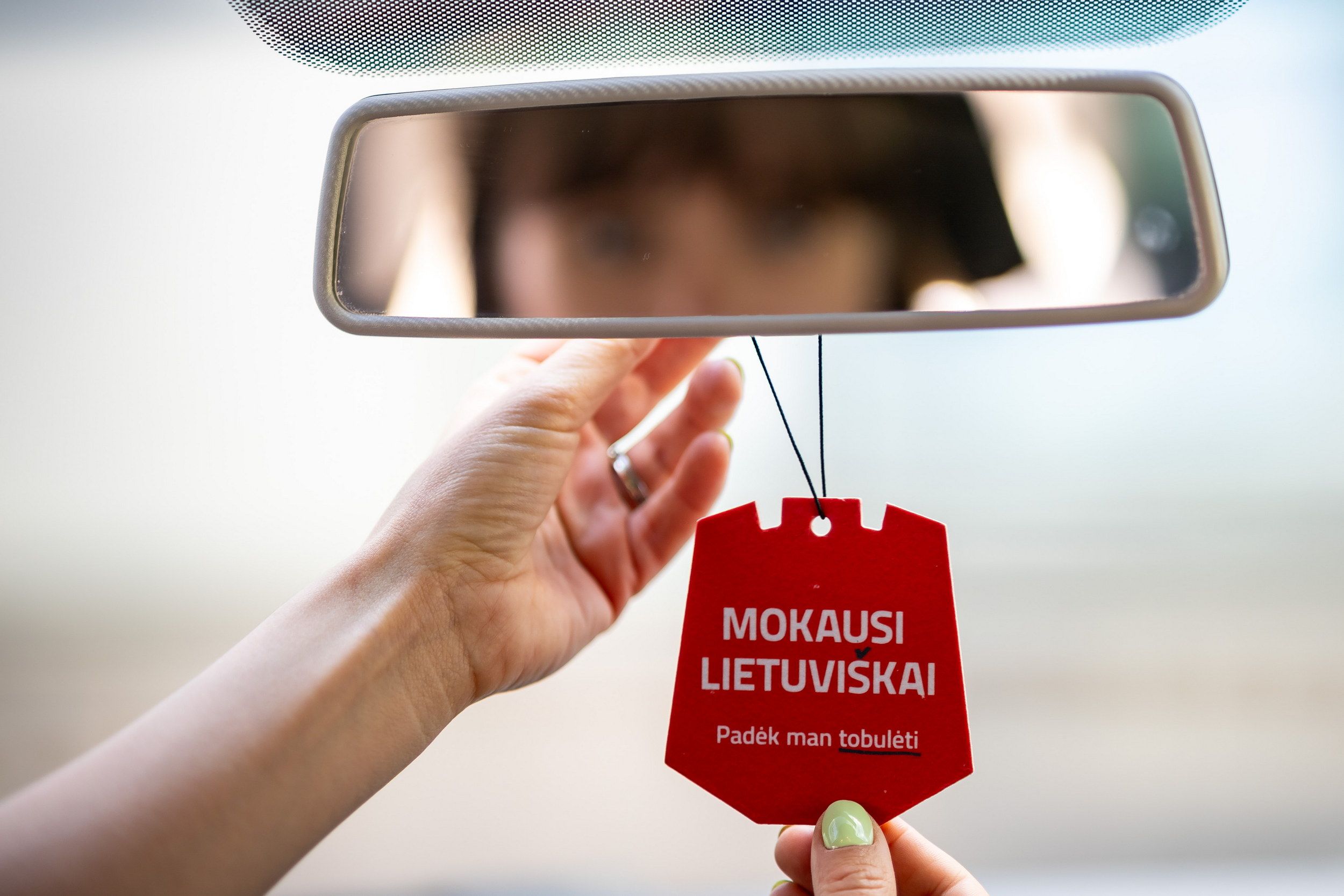
Local businesses are also being encouraged to participate. Companies employing foreign nationals can download and print sticker templates from the city’s dedicated language platform, askalbu.lt, to display at customer service points.
A Growing Demand for Integration
This initiative comes at a time when interest in the Lithuanian language is at an all-time high among the city’s foreign residents. The municipality reported that registration for free or subsidized language courses through the “Atvyk į Vilnių” (Coming to Vilnius) program often fills up within minutes of being announced.
For the international community in Vilnius, the challenge is a familiar one across many European capitals with high English proficiency, such as Amsterdam or Stockholm. In these environments, expats often complain that their attempts to speak the local tongue are met with immediate responses in English, creating a “fluency trap” where they can never reach an advanced level because locals are too accommodating.
Foreign residents currently learning the language can collect their “I am learning Lithuanian” car scents or stickers at the Vilnius City Municipality building during regular working hours. The city hopes that by making the learning process visible, it will transform the streets of the capital into a living classroom.
Source: Vilniaus miesto savivaldybė




Comments