
Glasgow’s 11-day Games experiment faces its next test
By the Beehive Web editorial team | Published 3 August 2026
More than 630,000 engagements with live sport, live sites and the Glasgow 2026 Festival have been recorded across an 11-day Commonwealth Games built around a smaller, privately funded model.
Organisers presented that figure alongside 1,168 medals, 215 medal events and 156,110 volunteer hours in an interim evaluation released as the Games ended. The totals demonstrate the event’s scale, but they are not yet a complete measure of unique visitors, economic impact or long-term benefit to Glasgow.
Glasgow 2026 in numbers
| Measure | Reported result |
|---|---|
| Competition | 11 days |
| Nations and territories | 74 |
| Sports | 10 |
| Para sports | 6 |
| Medal events | 215 |
| Medals | 1,168 |
| Public engagement | More than 630,000 |
| Volunteers | More than 4,000 |
| Volunteer hours | 156,110 |
| Social-media views | Nearly 500 million |
| Projected privately funded spend | £162.6 million |
The engagement total combines attendance at venues, live sites and festival activity. Social-media views indicate substantial online reach, although views are not equivalent to individual viewers.
For readers who followed the build-up, our earlier Glasgow Commonwealth Games visitor guide sets out how the dates, venues and public programme were presented before competition began.
Athletes contested 215 events across a compact Games
Athletes from 74 nations and territories competed across 10 sports. The programme included 47 Para sport events in six sports, described by organisers as the largest integrated Para sport programme in Commonwealth Games history.
A Para event opened the medal schedule for the first time, with England’s Mark Swan winning Para Powerlifting gold. Commonwealth Para Bowls champion Pauline Wilson said competing, training and socialising alongside other athletes showed spectators how inclusive bowls could be.
All venues were existing facilities within an eight-mile footprint. Glasgow received £4.7 million in venue upgrades, including a new track and replacement pitch at Scotstoun Stadium and work at Tollcross International Swimming Centre.
Volunteers contributed more than 156,000 hours
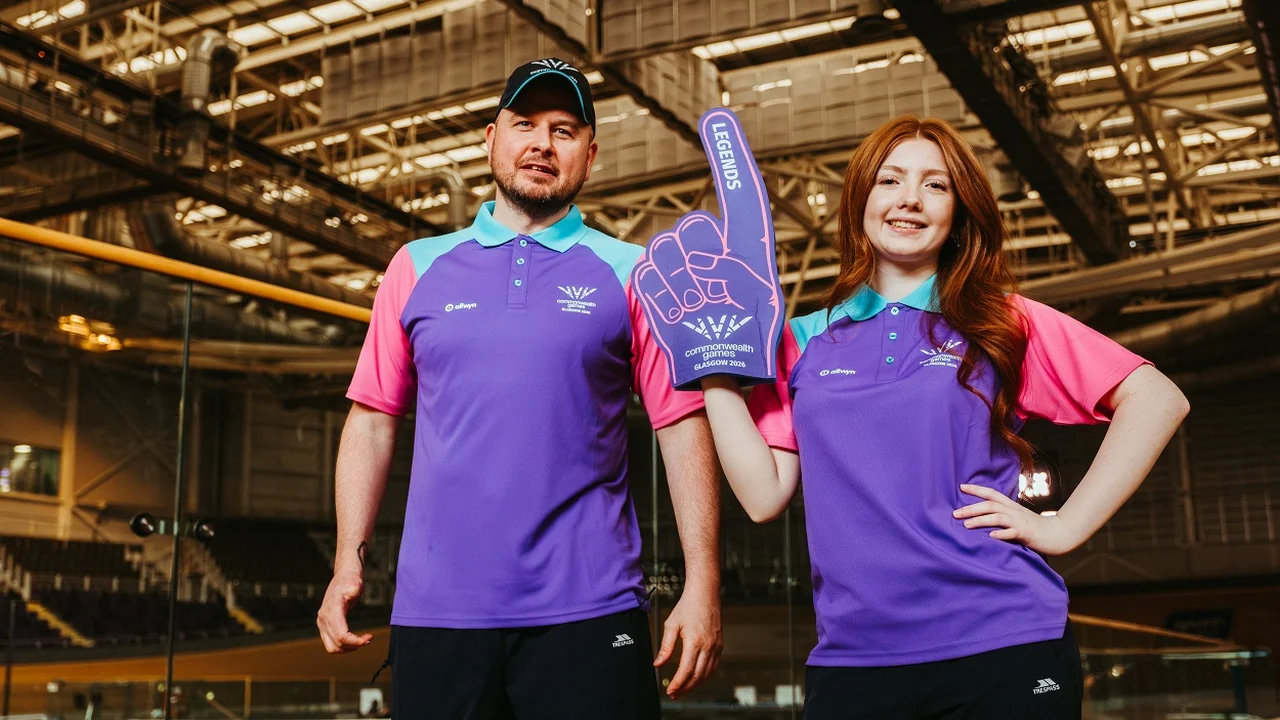
More than 4,000 volunteer “Legends”, aged from 16 to 96, contributed 156,110 hours. The Leading Women programme also brought together more than 900 women across 21 events to promote female leadership in sport.
Community participation extended beyond competition venues. More than 750 organisations joined the All In programme, while Glasgow Life’s Festival Fund awarded 161 grants covering all 23 city wards. A further £2.2 million from National Lottery Awards for All Scotland supported 110 Games-inspired projects across the country.
The cultural programme placed Glasgow imagery throughout the event, from a giant Nessie and flying police boxes to the Glasgow Rose displayed above the Clyde. Batons made from fallen city trees and medals incorporating braille connected the presentation of the Games with accessibility and local identity.
Interim report calls the model a proof of concept
The independent interim report, titled The Story So Far, was commissioned by Commonwealth Sport and the Glasgow 2026 Organising Company. The Bulb and the University of the West of Scotland’s Centre for Culture, Sport and Events are evaluation partners.
It describes Glasgow 2026 as a “proof of concept” for the Commonwealth Sport Movement and highlights an approximately 18-month delivery period involving around 400 staff. Its assessment follows four principles: a greener, more inclusive, welcoming and financially responsible Games.
The reported sustainability measures include renewable electricity at every competition venue, ISO 20121 certification and the reuse of more than 90% of temporary overlay structures. Organisers said 71% of Games transport was hybrid or electric, including 63% that was fully electric, while 99,401 recycled plastic bottles were repurposed as venue banners.
These are organiser-supplied operational results assessed in an interim document. They do not, by themselves, establish the Games’ full environmental footprint or lasting social and economic effects.
Full legacy verdict is still to come
Glasgow 2026 has a projected privately funded spend of £162.6 million, compared in the report with £543 million for Glasgow 2014 and £680 million for Birmingham 2022. The comparison points to a substantially leaner delivery model, but the editions differed in scale and circumstances, so headline budgets alone cannot establish equivalent value.
Chief executive Phil Batty said the event had shown that major Games could become more sustainable, accessible and affordable for prospective hosts. Commonwealth Sport chief executive Katie Sadleir described Glasgow as a bridge towards a more flexible hosting model.
The organising company is due to be dissolved by the end of 2026. A fuller evaluation later in the year will include athlete, volunteer and visitor surveys, an economic impact assessment and case studies—the evidence needed to judge whether the 11-day experiment produced benefits that lasted beyond the closing celebrations.
Source: Glasgow Life News
Context & actions About this article
Source check How this report was checked
The figures were traced to Glasgow Life’s 3 August 2026 account and presented with caveats where the final evaluation remains outstanding.
- Compared the medal, event, sport and participating-nation totals stated in the source.
- Distinguished combined public engagement from a count of unique visitors.
- Checked the reported volunteer total against the stated 156,110 volunteer hours.
- Marked spending, sustainability and legacy findings as interim or organiser-led where appr...
- Source
- Glasgow Life News
- Scope
- Glasgow
- Updated
- 2026-08-11 18:26
Source check
Report a trust issue
Send a clear signal to community moderation if the source, facts or context need review.


Comments