
Lithuania: 76% Favor Public Vote on Constitutional Family Definition

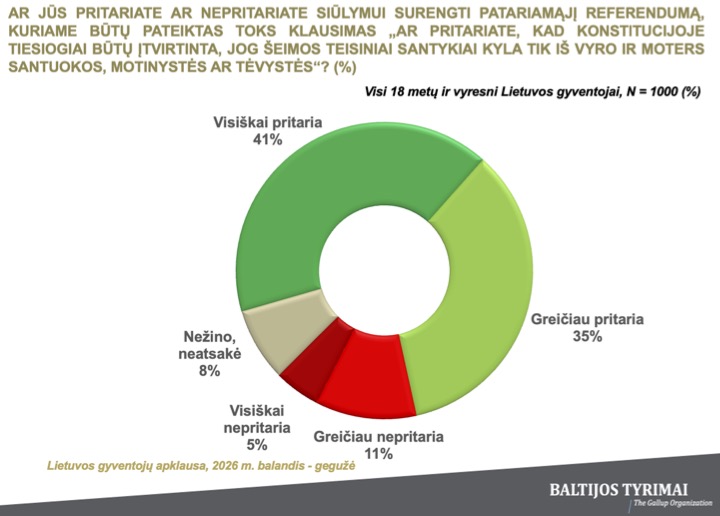
A significant majority of the Lithuanian population supports the idea of a consultative referendum to define the concept of ‘family’ within the nation’s Constitution. According to a representative survey conducted by the market and public opinion research company Baltijos tyrimai, 76% of respondents are in favor of a public vote on whether the Constitution should explicitly state that family legal relations arise only from marriage between a man and a woman, as well as from motherhood and fatherhood.
The data suggests a broad-based consensus that transcends typical demographic and political divides. While social issues in Europe often highlight a rift between urban and rural populations or between generations, the Lithuanian findings indicate a more unified stance on the procedural question of holding a referendum.
Breaking Down the Support for a National Vote
The survey reveals that support for the referendum is not only high but also deeply rooted across various social strata. Of the 76% who support the initiative, 41% stated they ‘completely agree,’ while 35% ‘somewhat agree.’ Only 16% of the population expressed opposition to the idea, with 8% remaining undecided.
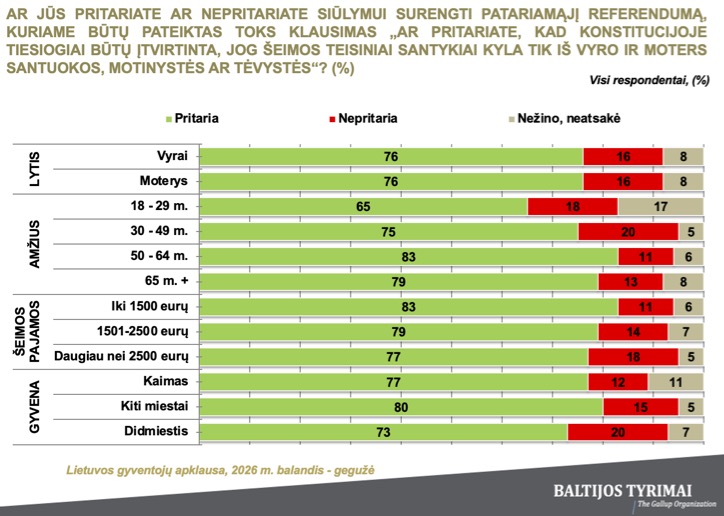
One of the most striking aspects of the data is the consistency across demographic groups. Even among younger citizens (under 29), who are typically viewed as more socially liberal, 65% support the referendum. In rural areas and smaller towns, support is even more pronounced, though nearly three-quarters of residents in major cities also back the initiative.
| Demographic Group | Support for Referendum (%) |
|---|---|
| Married Individuals | 78% |
| Divorced Individuals | 86% |
| Single Individuals | 63% |
| Youth (Under 29) | 65% |
| High Income Earners | 77% – 83% |
| Major City Residents | ~75% |
Political Alignment and Social Consensus
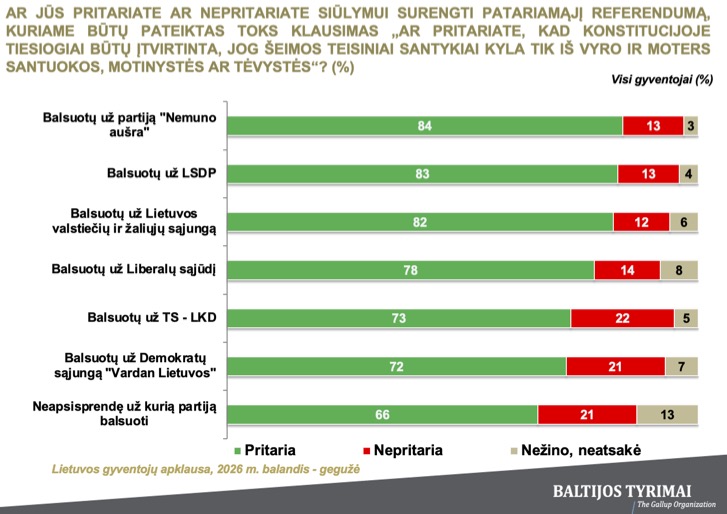
The survey also analyzed support based on political affiliation, showing that the desire for a referendum is shared by voters across the political spectrum. While the highest support comes from followers of the ‘Nemunas Dawn’ party (84%) and the Social Democrats (83%), substantial majorities of voters from the Liberal Movement (78%) and the conservative Homeland Union (TS-LKD) (73%) also favor the public vote.
This suggests that the demand for a referendum is viewed by many not necessarily as a partisan weapon, but as a legitimate tool for resolving a fundamental social question. The ‘consultative’ nature of the proposed referendum means it would serve as a formal expression of the public will to guide the Seimas (Parliament), rather than an immediate, legally binding change to the constitutional text.
Understanding the Scope and Limitations
While the 76% figure represents a powerful mandate for a public discussion, it is important to distinguish between support for holding a referendum and the eventual outcome of such a vote. The survey specifically asked about the initiative to hold a referendum regarding the definition of family as arising from marriage between a man and a woman.
Critics often argue that constitutional protections for minorities should not be subject to majority votes. However, the data indicates that the Lithuanian public largely views the definition of family as a matter of national self-determination that belongs in the hands of the electorate. The high support among divorced individuals (86%) is particularly noteworthy, suggesting that the preference for a traditional constitutional definition is not limited to those currently in traditional nuclear setups.
The Path Toward a Referendum
The survey, commissioned by the Free Society Institute (Laisvos visuomenės institutas), involved 1,000 residents across 111 sampling points in Lithuania. With a margin of error of 3.1%, the results provide a robust snapshot of current public sentiment as the Seimas continues to debate the initiative.
As Lithuania navigates the complexities of modernizing its legal framework while respecting traditional values, this data will likely play a central role in legislative arguments. The next steps involve the formal approval of the referendum’s wording and the setting of a date, a process that will require navigating both constitutional law and the intense public interest highlighted by these findings.
Source: ELTA




Comments