
Manchester scans reveal secrets of England’s 1966 World Cup ball
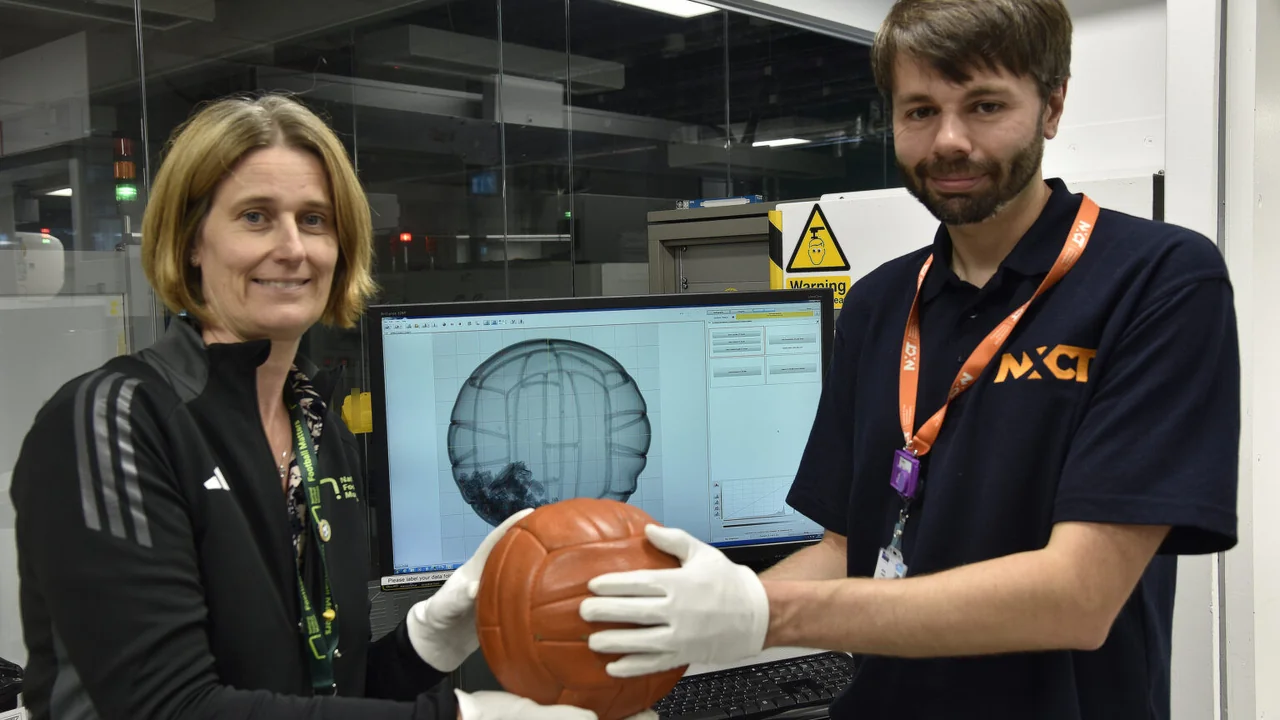
A football that helped define England’s greatest sporting afternoon has finally been examined from the inside.
Researchers at the University of Manchester and the National Football Museum have produced the first 3D X-ray scans of the Slazenger Challenge 4 Star used during the 1966 World Cup final at Wembley. The scans show the ball’s hand-stitched leather panels, stitching and the degraded latex bladder sealed inside it for six decades.
A Yorkshire-made ball built for black-and-white television
The ball was made at Slazenger’s works in Horbury, near Wakefield, where each Challenge 4 Star took around two-and-a-half hours to stitch by hand. It had to weigh between 14 and 16 ounces and measure 27 to 28 inches in circumference.
Read also: Ealing residents face the trade-offs of two data centres
Its orange colour was chosen for a practical reason: it stood out more clearly on the monochrome television sets used by millions of viewers in 1966. The ball earned its place in the final after winning a blind test of more than 100 footballs at The FA’s headquarters.
Sir Geoff Hurst struck it three times as England beat West Germany 4-2 in front of approximately 97,000 spectators. The match remains the only occasion on which England’s men have won the World Cup.
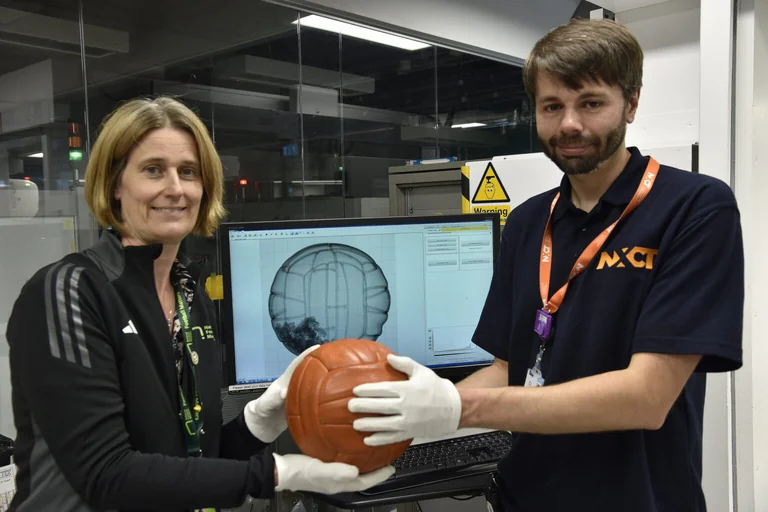
X-rays expose the craft beneath the leather
The Manchester investigation was carried out by NXCT at the University of Manchester using X-ray computed tomography. The non-destructive technique allowed researchers to look inside the historic object without opening or damaging it.
Dr Matthew Lawson said the scans revealed the composition of the leather panels, the stitching and the perished air bladder in unusual detail. Although a football is mostly air, the imaging showed how its materials and construction reflected the manufacturing methods of the period.
The results also offer a striking contrast with the ball used in the 2026 World Cup final. The modern Trionda is made from four thermally bonded panels using polyurethane, polyester, viscose and synthetic rubber, and includes an inertial measurement unit sensor to track contacts and changes in position.
In 1966, the equivalent technology was needle and thread.

From Helmut Haller’s hands to Manchester’s museum display
The ball’s story continued after the final whistle. Helmut Haller, who scored West Germany’s opening goal, took it back to Germany, citing the tradition that the first scorer could keep the match ball.
It remained there for 30 years before a consortium involving Mirror Group, Virgin and Eurostar bought it for £80,000 and returned it to England ahead of Euro ’96. The initials on its surface were signed by Uri Geller during a pre-tournament publicity stunt.
The ball is now on permanent display in the National Football Museum’s “England on the World Stage” section, alongside Hurst’s hat-trick shirt and other objects from the final. The museum is marking the anniversary on Thursday 30 July with talks from its Visitor Experience team about the 1966 tournament and final.
Source: University of Manchester News
Context & actions About this article
Source check Source trail
The article was checked against the University of Manchester’s 30 July 2026 account of the scans, the ball’s history and the museum display.
- Confirmed the scan method as X-ray computed tomography.
- Checked the ball’s 25-panel construction, hand-stitching and degraded latex bladder detail...
- Checked the 1966 final score, attendance figure and ball ownership history.
- Checked the comparison with the sensor-equipped 2026 Trionda.
- Source
- University of Manchester News
- Scope
- Manchester
- Updated
- 2026-07-31 10:47
Source check
Report a trust issue
Send a clear signal to community moderation if the source, facts or context need review.




Comments