
Ealing streets cleared of 1,000 abandoned cars and luxury vehicles

Ealing residents are seeing a significant shift in local parking availability following a major enforcement operation that has removed more than 1,000 abandoned vehicles from the borough’s streets and housing estates. The intensive crackdown, which launched in September 2025, reached the four-figure milestone in just seven months, representing a massive increase in activity compared to previous years.
Data from the first phase of the operation shows that the vast majority of these vehicles were lifted from public highways. However, enforcement teams also targeted residential areas, removing 125 vehicles from council housing estates and two from private land. This surge in removals marks a sharp departure from the council’s typical annual average of approximately 400 vehicle seizures.
Luxury models and weapons discovered during borough-wide sweep
While many abandoned vehicles are typically older models in disrepair, this specific operation has uncovered a surprising number of high-end luxury cars left to rot on residential streets. Enforcement officers reported seizing a Maserati, a Rolls Royce, a Jaguar, and several Audis. The presence of these prestige brands among the 1,000 removals has drawn significant attention to the scale of the issue in West London.
Beyond the high-value cars, the crackdown has also addressed public safety concerns. In one instance, a search of a seized vehicle led to the discovery of a machete and a quantity of Class A drugs. These findings highlight the link between abandoned vehicles and broader criminal activity, reinforcing the council’s stance that stationary, untaxed cars often act as magnets for anti-social behavior.
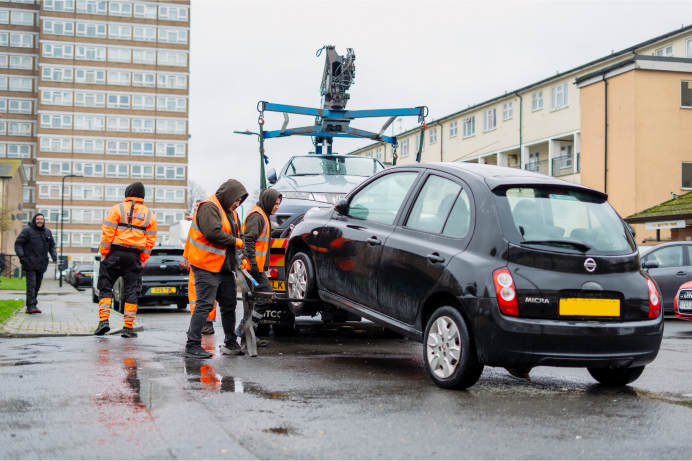
Significant increase in vehicle removals across housing estates
Councillor Dominic Moffitt, the cabinet member for climate action, noted that the presence of abandoned cars causes persistent frustration for residents who struggle to find legitimate parking spaces. The council’s towing contractor has been instructed to maintain a constant presence at known hotspots for vehicle dumping, moving to seize cars almost immediately once they are identified as meeting the criteria for abandonment.
This proactive approach aims to prevent neighborhoods from feeling neglected. By removing more than 1,000 vehicles in such a short timeframe, the local authority is attempting to disrupt the cycle where one abandoned car encourages others to dump vehicles or litter in the same vicinity. The operation remains active, with enforcement officers continuing to patrol housing estates and respond to direct reports from the public.
Legal requirements for parking on public and residential land
For a vehicle to be legally parked on a public road or within a council housing estate in the borough, it must meet several strict criteria. Owners are required to maintain valid road tax, a current MOT certificate, and active insurance. The vehicle must also remain in good working order; cars that are clearly undriveable or damaged are prioritized for removal.

Financial liabilities also play a role in the definition of an abandoned vehicle. If a car has a significant backlog of unpaid penalty charge notices (PCNs), it can be flagged for seizure. Once a vehicle is towed, the owner is required to pay a release fee to reclaim it. Any vehicles that remain unclaimed after a set period are either sold at public auction or sent to be scrapped.
Specific regulations also apply to commercial activities and off-road notices. Commercial garages are strictly prohibited from operating or storing vehicles on housing estates. Furthermore, vehicles declared with a Statutory Off-Road Notification (SORN) are not permitted to be parked on the public highway or within council-managed residential parking areas. Residents who suspect a vehicle has been abandoned are encouraged to submit reports via the council’s official website or the Love Clean Streets mobile application to trigger an investigation by enforcement teams.
Source: Ealing Council



Comments