
The 10km Commute: Why This Forester Swaps His Car for a Horse
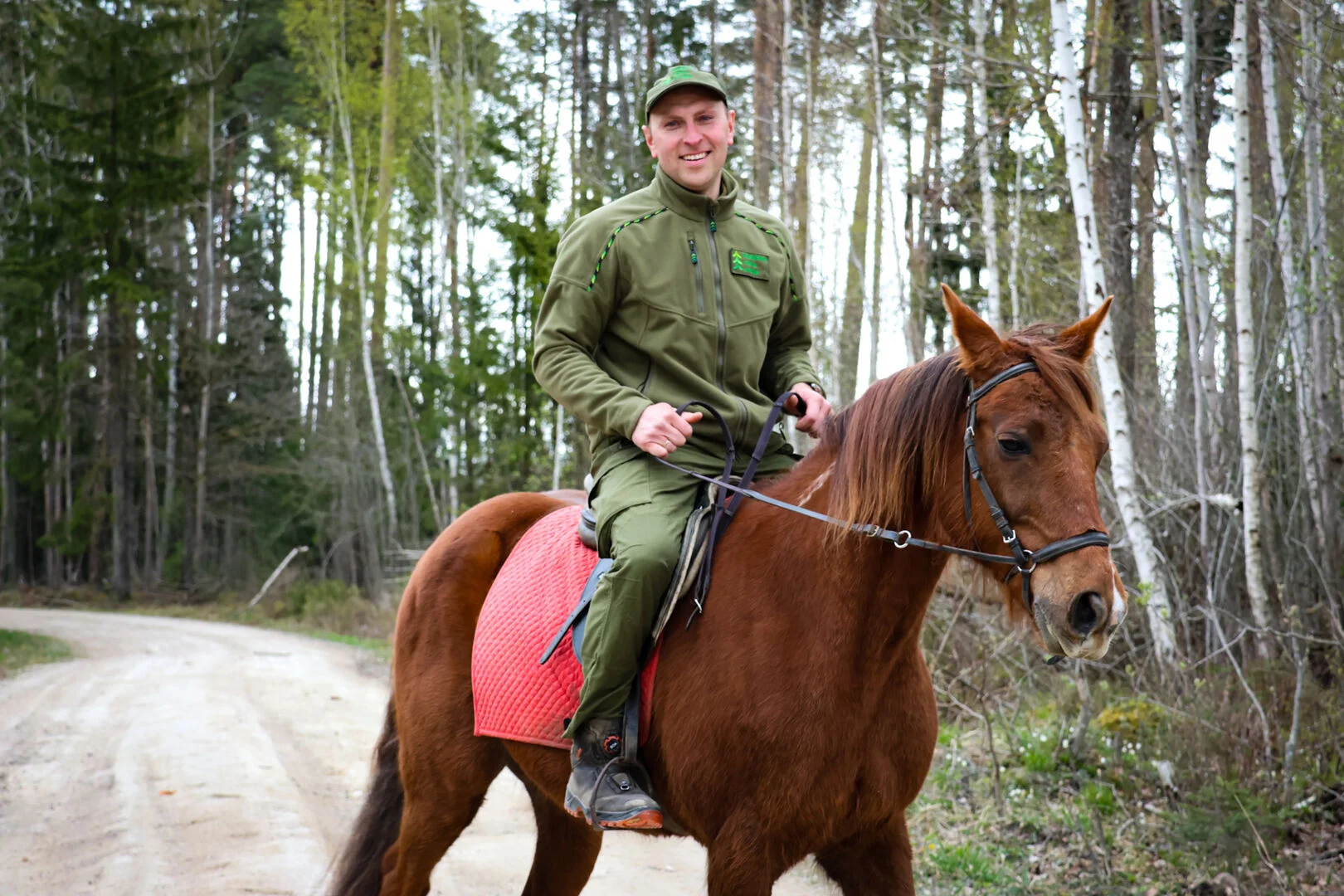
While most commuters across Europe are grappling with morning traffic and rising fuel costs, Gediminas Vitkauskas, a forester in the Žagarė district of northern Lithuania, chooses a different path. Several times a week, he sets aside his car keys and saddles up his horse, Tomis, for a ten-kilometre journey through the woodland he is sworn to protect.
The ride takes about an hour—significantly longer than a drive—but for Vitkauskas, the time is an investment rather than a loss. In an age of digital urgency, his commute offers a rare opportunity to observe the forest’s subtle changes, track wildlife, and escape the frantic pace of modern life. It is a practical application of ‘slow living’ in a profession that has long been the backbone of rural Baltic communities.
A trotter with a colourful past
The horse at the centre of this story, an American Trotter named Ilves Toma (affectionately known as Tomis), was never intended to be a quiet commuter. Bred for speed, Tomis has a lineage that traces back to Sweden and a competitive history that includes the Sartai races—Lithuania’s legendary winter horse racing tradition held on ice. However, Tomis was not destined for the winner’s circle; after finishing last in several races, his previous owners decided to sell him.

When Vitkauskas found Tomis through a classified ad, the horse was suffering from chronic health issues. A veterinary examination revealed that the former racer was severely allergic to dust and common hay. This meant Tomis could never live in a traditional stable or eat standard fodder. For many, this would be a burden, but for a forester with a homestead in the village of Spirakiai, it was a perfect match. Tomis now lives entirely outdoors, growing a thick, ‘mammoth-like’ coat in the winter and dining on fresh grass or specialized silage.
The forester as a community pillar
Vitkauskas’s connection to the woods is hereditary; his father was a forester and his mother a forest guard. Growing up in a remote homestead, he admits he once envied his classmates who lived in the city near cinemas and friends. Today, however, he views the forest as his primary source of entertainment and value, raising four children alongside a menagerie of royal pheasants, geese, and dogs.

Since taking up his post in 2013, Vitkauskas has seen the role of the forester evolve. While the job is often romanticised as a solitary life among the trees, the reality involves complex management, psychological insight, and public relations. In Lithuanian tradition, the forester was historically held in the same high regard as the local priest, teacher, or doctor. It is a standard of service Vitkauskas strives to maintain, balancing the needs of the timber industry with environmental conservation and community expectations.
Life on a forest homestead
Living so closely with a 14-year-old trotter brings its own set of unique challenges. Tomis has become a fixture of the family’s daily life, often peering through the farmhouse window during dinner and tapping the glass with his nose to request a carrot or a slice of bread.

However, the bond isn’t without its mishaps. Vitkauskas recalls with a laugh how the horse once dented a visitor’s car after being startled by children blowing soap bubbles. On another occasion, Tomis used the family car as a rubbing post during a sand bath, leaving a horse-shaped dent in the bodywork.
Despite the occasional repair bill, the trade-off is clear. For Vitkauskas, the rhythmic hoofbeats on the forest floor represent a rejection of the ‘rush’ that defines the 21st century. It is a reminder that sometimes, the best way to move forward is at the pace of a horse.
Source: BNS


Comments